

ChatGPT Now Has Ads: What It Means for Beginners
If you’ve been using the free version of ChatGPT lately, you may have noticed something new popping up at the bottom of your answers. Yep, ChatGPT ads are officially here. And if your first reaction was “wait, really?”, you’re not alone. A lot of people are wondering what this means for them and whether they need to do anything about it. Honestly, the answer is: probably not much. But it’s worth understanding what changed, so let me break it down in plain English.
Back in February 2026, OpenAI started testing ads inside ChatGPT for logged-in users on the free tier. This is a big deal because until now, ChatGPT has been completely ad-free. You just typed your question and got your answer with nothing commercial in between.
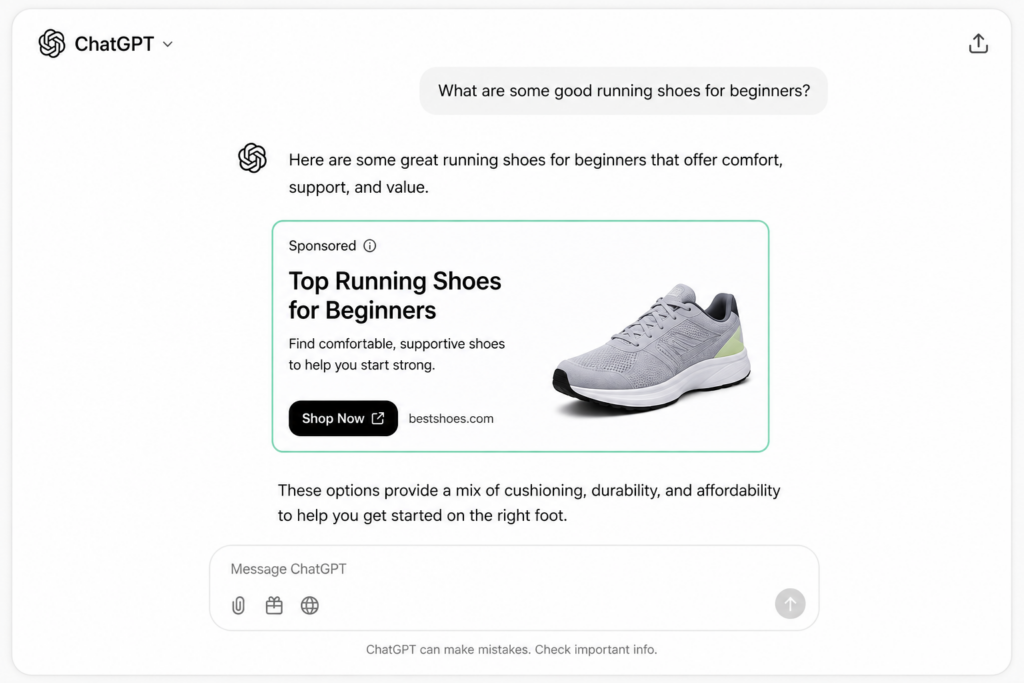
The ads are clearly labeled as “Sponsored” and visually separated from ChatGPT’s actual answer, so they don’t appear mixed in with the information you asked for. Think of it a bit like a Google search result, where you sometimes see a couple of sponsored listings above the regular ones. It’s the same idea, just in a different format.
The reason OpenAI did this? Running a tool that hundreds of millions of people use every day is genuinely expensive, and ads help fund keeping the free tier fast and available. Fair enough, really.
Who Sees the Ads?
Here’s the part that matters most to you. Ads only appear to users on the free tier and the ChatGPT Go tier (the $ 8-per-month subscription). If you’re on Plus ($20 per month), Pro, Team, or any business or education plan, you won’t see any ads.
So if you’re a free user, which most people are, you’ll start seeing sponsored content show up at the bottom of some responses. Not every response, and not in sensitive conversations. OpenAI has confirmed that no ads will appear in conversations about health, mental health, or politics, regardless of your subscription.
There’s also an opt-out of sorts. If you’d rather not see ads at all, you can manage your ad personalization settings, dismiss individual ads, delete your ad data with one tap, and even see exactly why a particular ad was shown to you. It’s actually a decent amount of control compared to most platforms.
What About Your Privacy?
This is the question I know a lot of you are thinking about. The short answer is: OpenAI says your conversations stay private.
OpenAI has stated that advertisers won’t have access to your actual conversations, only to basic performance data such as views and clicks. Your chats stay private, and ads are matched to your conversations based on topic rather than by handing your personal data to a third party.
For example, if you’re asking ChatGPT about recipes, you might see an ad for a grocery delivery service. The system reads the general topic of your conversation and serves a relevant ad, but the advertiser doesn’t get to see what you actually typed.
Is that reassuring? Mostly, yes. Though, as with anything online, it’s always worth keeping an eye on things as this develops.
Is the Free Version Still Worth Using?
Yes, it is. But it helps to know its limits, because I remember hitting them myself when I first started using ChatGPT and having no idea why it suddenly stopped letting me ask questions.
What you ran into is called a message limit. Free users can send up to 10 messages every 5 hours using the full version of the model. After that, ChatGPT automatically switches you to a lighter version of the model until your limit resets. The lighter version is still capable of simple tasks, but you’ll notice the answers feel a bit less detailed or thorough on trickier questions.

So if you were in the middle of a big research session or working through something complex and suddenly got cut off, that’s why. You’d just used up your allowance for that window and had to wait it out. Very frustrating when you don’t know what’s happening!
If you’re brand new to ChatGPT and still finding your feet, my post How to Use ChatGPT for Beginners walks you through everything from scratch.
What Do You Actually Get If You Upgrade?
This is where it gets interesting, because upgrading does make a real difference to your experience.
ChatGPT Plus at $20 per month is the first step up, and honestly, it’s worth considering if you use ChatGPT regularly. Plus users can send up to 160 messages every 3 hours, compared to just 10 on the free plan. That’s a massive jump, and it means you can have long, in-depth conversations without suddenly being cut off mid-flow. You also get priority access during busy periods, so you’re not stuck waiting while the free tier slows down. No ads either, which is now an added bonus.
ChatGPT Pro at $200 per month is a big price jump, but the difference in quality is very real. Pro users get unlimited access to the most powerful version of the model, including the advanced “thinking” mode that carefully works through complex problems before answering. If you’re using ChatGPT for serious work, detailed research, or anything where the quality of the answer really matters, Pro answers do feel noticeably better and more considered. It’s definitely not for everyone at that price, but for heavy daily users, it’s a different tool entirely.

For most beginners, though, the free version is a perfectly good place to start. Just know the limits exist, and don’t be surprised when you hit them!
How Does Claude Compare as an Alternative?
Here’s something worth knowing. When ChatGPT’s ads launched, Anthropic, the company behind Claude, ran Super Bowl ads that gently poked fun at AI tools, showing poorly timed ads mid-conversation. The message was pretty clear: Claude products are ad-free.
So if you’re already feeling a bit “hmm” about the ChatGPT changes, it might be a good time to try Claude. It’s free to use, and the experience is clean and straightforward with no sponsored content interrupting your conversation. I’ve been using it alongside ChatGPT for a while now, and in my experience, it’s brilliant for writing tasks, asking thoughtful questions, and working through ideas. Both tools are worth having in your toolkit.
If you want to explore that properly, I’ve written a full ChatGPT vs Claude comparison that breaks down which one suits different types of people.
Should You Do Anything Right Now?
Honestly, for most beginners, the answer is: not necessarily. The ads are pretty unobtrusive so far, your privacy is reasonably protected, and the free tier is still very much free.
That said, here are a few simple things you can do if you want more control:
- Adjust your ad settings inside ChatGPT and manage your personalization and ad history anytime
- Try Claude at claude.ai if you want a completely ad-free experience (it’s free)
- Consider upgrading to ChatGPT Plus if you find yourself hitting the message limit regularly or if the ads bother you
The bigger picture here is that AI tools are growing up and figuring out how to pay the bills. Ads are a pretty normal part of that journey. For now, the ChatGPT free tier is still a solid tool, though it sometimes shows a small sponsored note at the bottom.
The Bottom Line on ChatGPT Ads
If you’re a free ChatGPT user, ads are now part of your experience. They’re labeled, they’re separated from the real answers, and your conversations stay private. It’s not a huge deal, but it is a change worth knowing about.
And if it nudges you to explore what else is out there, like Claude, that’s not a bad thing either. Having more than one AI tool to choose from is always a good idea.

I'm Brenda and I help AI Beginners to become confident in using ChatGPT and other Ai Tools.
Read more about me

I'm so glad you're here
Hello!
For tips and updates follow me on Instagram @brendahumphreysjones

TAKE THE
1-MINUTE SURVEY
Want to know if you’re prepared for an unexpected legal issue?